
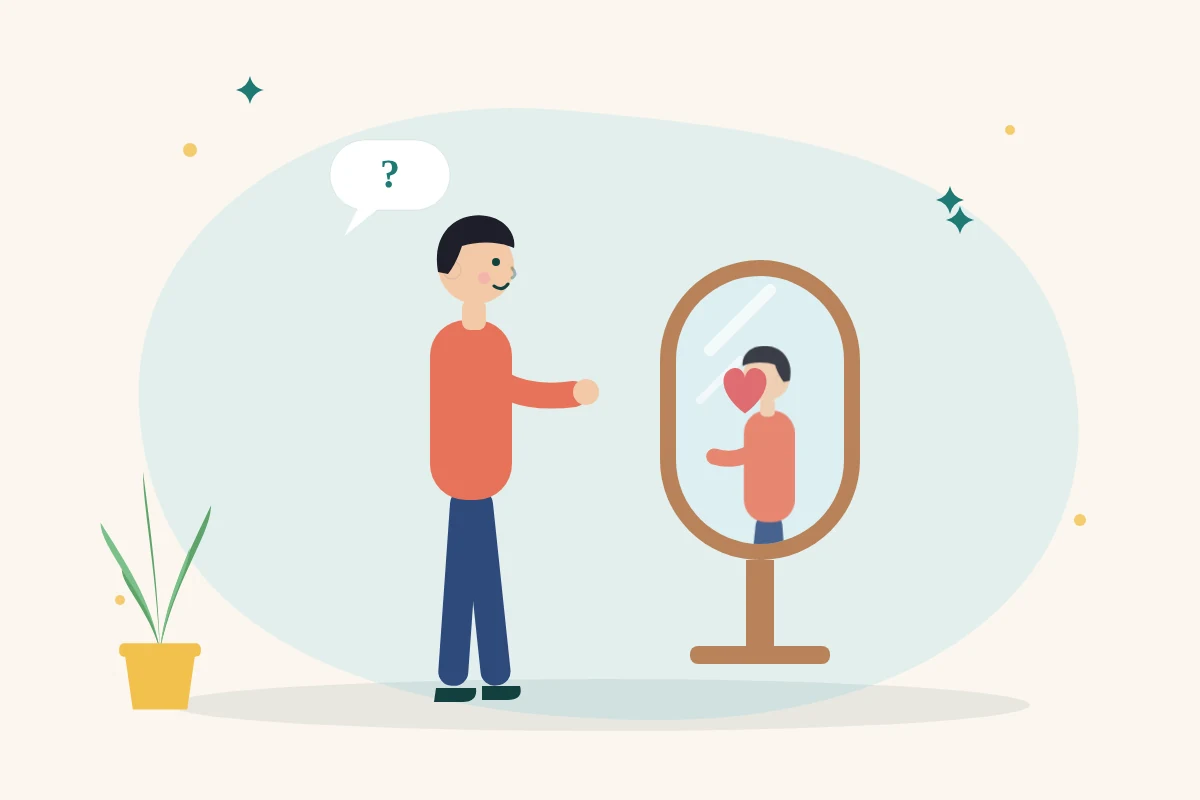
Jacques Lacan (1901–1981) is one of the most influential and debated figures in psychoanalysis. A Paris psychiatrist, from the 1950s onwards he called his work a "return to Freud", rereading Freud through linguistics, philosophy and anthropology.
Love recurs throughout the seminar he taught for nearly three decades, yet he offered no single theory of it. He approached it as captivation by an image, as a request made to another person, as a response to the lack at the heart of desire, and as what makes up for two people never fitting together perfectly.
This article is part of the Psychoanalysis of Love series. It explains Lacan's main ideas on love and their vocabulary in plain terms, and what they offer, and do not offer, to relationships and psychotherapy.
The mirror: why love begins with an image
Lacan's first major contribution was his account of the mirror stage, first presented in 1936 and published in its best-known version in 1949.
Between roughly six and eighteen months, he argued, a baby recognises its reflection with delight. Its bodily experience is still scattered, yet the image looks whole. The child identifies with it and takes it as a picture of who it is.
So the ego, our sense of "me", is built from an image that comes from outside. From the start it contains an element of misrecognition: we take ourselves to be more unified than we are.
This is the basis of the imaginary, one of three "registers", or dimensions of experience, through which Lacan described human life. The other two are the symbolic (language, rules and shared meanings) and the real (what cannot be put into words or images); see the overview of Lacanian terminology. The imaginary is the world of images, resemblance, identification and rivalry, where relationships swing between fascination and aggression.
At this level, love is mainly narcissistic. Lacan builds on Freud's On Narcissism (1914), where one way of choosing a partner means to love what one is, was or would like to be (see Freud on Love). Much of what we love in the other is our own ego, or our ideal of ourselves, reflected back. This helps to explain:
- the sense of having found a "soulmate" just like us
- preoccupation with how we look in the beloved's eyes
- sudden hostility when the partner stops reflecting the flattering image
Winnicott later described the mother's face as the baby's first mirror (see Winnicott on Love), though he gave far more weight to the real caregiver's responsiveness.
Need, demand and desire: what we are really asking for
Lacan did not think images alone explain love. To see why, three terms he distinguished in the late 1950s, notably in "The Signification of the Phallus" (1958), are essential.
- Need is biological: hunger, thirst, warmth. In principle it can be satisfied.
- Demand appears when a need must be put into words, or cries, addressed to someone else. Because the infant depends on a caregiver, every request for a thing also carries a hidden message: show me that you are there for me. In this sense every demand is ultimately a demand for love. The milk can be given; the other's presence can never be fully guaranteed.
- Desire is what is left over when the satisfaction of the need is taken away from the demand for love. No particular object can fill it, so it keeps moving from one thing to another.
Following the philosopher Alexandre Kojève's reading of Hegel, Lacan also held that "desire is the desire of the Other". People desire what others desire, they desire to be desired and recognised, and what they desire is shaped by language and by the wishes of those who raised them. "The Other", with a capital O, is not a particular person but the whole order of language, rules and expectations into which we are born, often first represented by the parents.
This applies directly to couples. Partners often ask for messages, time or gifts that work as signs rather than goods. A partner may meet every practical request and still hear "that is not what I meant", because what is sought is proof of love, not the object. A message during a busy day matters less for its content than for showing that the other was thinking of us.
Lack and "object a": the something we cannot name
For Lacan, becoming a speaking, social being means giving up the fantasy of complete, direct satisfaction. This loss is built into human life rather than the loss of something we once had. What it leaves behind he called objet petit a ("object a").
Despite the name, object a is not an object in the everyday sense, nor the thing we desire. It is the cause of desire: the elusive "something" that makes a particular person, voice or gaze compelling, as when a lover says "it is not his looks, it is something else".
In Seminar XI (1964), Lacan suggested that the lover loves in the beloved something more than the beloved. The real person can never fully match the treasure we see in them, which is one way of understanding the disappointment that follows idealisation.
What Plato's Symposium taught Lacan about love
Lacan's fullest discussion of love is in his seminar on Transference (Seminar VIII, 1960–61). Much of it reads Plato's Symposium, in which banquet guests make speeches praising Eros, the god of love. Lacan focused on the ending, when the drunken Alcibiades bursts in and speaks of his love for Socrates.
The lover and the beloved
From Greek usage, Lacan took the distinction between the erastes, the lover, and the eromenos, the beloved.
- The lover is defined by lack: he seeks something without knowing exactly what.
- The beloved seems to have something, without knowing what makes him desirable.
What one lacks is not what the other has. Love arises, Lacan proposed, through a change of position he called the "metaphor of love": the moment when the beloved turns towards the lover and becomes a lover in turn, admitting a lack of their own. In everyday terms, love becomes mutual when the admired person also lets themselves need the other.
The hidden treasure and Socrates' refusal
Alcibiades compares Socrates to statues of Silenus: rough figures that opened to reveal precious images of the gods. Lacan used the Greek agalma, a precious ornament, for the hidden value a lover sees in the beloved, an idea closely related to object a.
Socrates refuses the role Alcibiades offers. He does not act as though he holds the treasure, and points Alcibiades towards his real interest, the poet Agathon. Lacan saw this as a model for the analyst, who neither claims what the patient imagines nor exploits that belief.
"Giving what you do not have"
Here Lacan's best-known formula returns: love is "giving what you do not have", a phrase found in several texts and seminars from the late 1950s onwards.
Love is not the gift of a possession such as money or status, which can be given without the giver feeling incomplete. To love is to give one's lack: to admit one is incomplete, and that the other matters because of what one does not have. So a partner who gives generously but never admits need may be experienced as not loving at all.
"There is no sexual relationship": why two halves never make a whole
In the early 1970s Lacan made the provocative claim that "there is no sexual relationship" (il n'y a pas de rapport sexuel), developed most fully in Seminar XX, Encore (1972–73).
He did not deny that people have sex. The French rapport also means ratio or proportion: his point was that no formula makes two sexed beings fit together as matching halves. Each partner relates less to the other as such than to their own fantasy and object a. Aristophanes' myth in the Symposium, of lovers as two halves seeking reunion, is exactly the illusion Lacan rejected.
In Encore, love is what makes up for (supplée) this missing relationship: a supplement that lets two people meet across a gap that cannot be closed. Lacan also remarked that love demands love and never stops demanding it, hence the title Encore ("again", "more"). Love does not remove the lack between partners; it is how human beings live with it.

Love, desire and jouissance: three things we often confuse
Lacan separated three dimensions that everyday speech tends to merge.
- Love belongs to the imaginary (the narcissistic image) and the symbolic (the request, the spoken "I love you"). It aims at unity and seeks to be returned.
- Desire is kept alive by lack and object a. It moves between objects and tends to fade once completely satisfied.
- Jouissance is a French word for an intense, bodily kind of satisfaction that goes beyond what Freud called the pleasure principle, the tendency to seek pleasure and avoid unpleasure. It can include suffering and is often tied to symptoms and repeated patterns.
These need not go together. A person may love without desiring, desire without loving, or keep returning to a painful relationship because of the jouissance it provides.
In Seminar X, Anxiety (1962–63), Lacan remarked: "Only love allows jouissance to condescend to desire." Put simply, love can soften a raw, potentially destructive satisfaction into desire for a particular person. Freud's 1912 observation that some cannot desire where they love can be reread this way.
Transference love and the "subject supposed to know"
Like Freud in "Observations on Transference-Love" (1915), Lacan saw the love arising in analysis as genuine. In Seminar XI he explained transference, the feelings a patient develops towards the analyst, through what he called the subject supposed to know.
A person entering therapy assumes the analyst knows the meaning of their suffering and symptoms. Wherever such a knower is supposed, transference follows, and this belief easily turns into love.
As with Socrates, the analyst neither accepts this position as true nor exploits it, but uses it to set the work in motion, while the patient gradually discovers that the knowledge sought lies in their own speech. A contrasting object-relations approach is described in the article on transference-focused psychoanalysis.
Courtly love: why distance keeps desire alive
In The Ethics of Psychoanalysis (Seminar VII, 1959–60), Lacan discussed medieval courtly love, in which a poet devotes himself to an idealised, unreachable Lady. He treated it as sublimation, which he defined as raising an object "to the dignity of the Thing". By "the Thing" he meant the place of something that can never be reached. The obstacles between poet and Lady are not accidental: they keep up the distance that keeps desire alive.
Why Lacan's ideas matter in therapy
Several of Lacan's ideas are used by psychodynamic therapists well beyond his school, and help make sense of patterns such as:
- Idealisation and disappointment. A partner first seems incomparable, later unbearably ordinary. This need not mean a wrong choice: no real person can embody the agalma.
- Demands that are never satisfied. One partner keeps asking, the other keeps giving, and neither is satisfied: a confusion between need and the demand for love.
- Love without desire. The idea that desire needs distance helps when discussing fading sexual interest in long-term relationships, without concluding that love has ended.
- The hope of being made whole. Hoping the right partner will make one complete, and feeling betrayed when this fails, is central to Lacan's account. Therapy may involve tolerating incompleteness rather than seeking a perfect match.
- Painful attachments. Jouissance helps address repeated attraction to relationships that cause suffering, a pattern Fairbairn approached in different terms (see Fairbairn on Love).
- The relationship with the therapist. Attachment to the therapist rests partly on a supposition, to be neither gratified nor rejected.
Criticisms and limitations
Lacan's ideas have been challenged on several grounds:
- Difficulty of style. His allusive, paradoxical writing, dense with references to philosophy, linguistics and mathematics, makes his claims hard to state clearly, critics argue, let alone test. Sokal and Bricmont (1998) criticised his use of mathematical and topological terms as superficial.
- Practice and evidence. His variable-length, often very short, sessions contributed to his break with the International Psychoanalytical Association, and Lacanian therapy has produced little outcome research of the kind available for other approaches.
- Gender. Feminist writers, including Luce Irigaray, a former member of his school, challenged the central role he gave to the phallus and his account of feminine sexuality, though others have used his ideas for their own critiques of gender.
- Real care. Compared with object relations and attachment theory, Lacan says little about the real care and responsiveness of caregivers, which is central to Bowlby and attachment theory.
- Reciprocity. His scepticism about mutual love contrasts with Jessica Benjamin's account of mutual recognition, which draws on the same Hegelian sources but reaches more hopeful conclusions.
Supporters reply that the difficulty of Lacan's work reflects the difficulty of the unconscious itself, and that it refuses to present love as a problem solved by finding the right partner or technique.
Conclusion
Lacan's view of love is neither romantic nor simply cynical. He showed how love draws on images formed in the mirror stage, how every demand hides a request for love, and how desire lives on a lack no partner can fill. From the Symposium came the idea that love begins when a person gives what they do not have, revealing their incompleteness; from Encore, the view of love not as the fusion of two halves but as what allows two incomplete people to meet across a gap. Where longing or repeated disappointment in love causes distress, psychodynamic psychotherapy offers a setting in which these patterns can be explored; online sessions can be booked here.
References
- Evans, D. (1996). An Introductory Dictionary of Lacanian Psychoanalysis. Routledge.
- Fink, B. (1997). A Clinical Introduction to Lacanian Psychoanalysis: Theory and Technique. Harvard University Press.
- Fink, B. (2016). Lacan on Love: An Exploration of Lacan's Seminar VIII, Transference. Polity.
- Freud, S. (1912). On the universal tendency to debasement in the sphere of love. Standard Edition, 11.
- Freud, S. (1914). On narcissism: An introduction. Standard Edition, 14.
- Freud, S. (1915). Observations on transference-love. Standard Edition, 12.
- Irigaray, L. (1985). This Sex Which Is Not One (C. Porter & C. Burke, Trans.). Cornell University Press. (Original work published 1977)
- Lacan, J. (1977). The Four Fundamental Concepts of Psycho-Analysis: The Seminar of Jacques Lacan, Book XI (J.-A. Miller, Ed.; A. Sheridan, Trans.). Hogarth Press. (Seminar delivered 1964)
- Lacan, J. (1992). The Ethics of Psychoanalysis: The Seminar of Jacques Lacan, Book VII (J.-A. Miller, Ed.; D. Porter, Trans.). Routledge. (Seminar delivered 1959–60)
- Lacan, J. (1998). On Feminine Sexuality, the Limits of Love and Knowledge: Encore, The Seminar of Jacques Lacan, Book XX (J.-A. Miller, Ed.; B. Fink, Trans.). W. W. Norton. (Seminar delivered 1972–73)
- Lacan, J. (2006). Écrits: The First Complete Edition in English (B. Fink, Trans.). W. W. Norton. (Original work published 1966)
- Lacan, J. (2014). Anxiety: The Seminar of Jacques Lacan, Book X (J.-A. Miller, Ed.; A. R. Price, Trans.). Polity. (Seminar delivered 1962–63)
- Lacan, J. (2015). Transference: The Seminar of Jacques Lacan, Book VIII (J.-A. Miller, Ed.; B. Fink, Trans.). Polity. (Seminar delivered 1960–61)
- Plato. (1989). Symposium (A. Nehamas & P. Woodruff, Trans.). Hackett.
- Sokal, A., & Bricmont, J. (1998). Fashionable Nonsense: Postmodern Intellectuals' Abuse of Science. Picador.
- Winnicott, D. W. (1971). Mirror-role of mother and family in child development. In Playing and Reality. Tavistock.